
You handle complex electrical needs for your business, and a commercial electrician gives you the skills and licensing to keep operations safe and code-compliant. A qualified commercial electrician installs, maintains, and troubleshoots high-capacity systems so your facility stays functional and up to code.
Knowing what to expect from commercial electricians helps you hire the right team, budget accurately, and avoid downtime. This article walks through what a commercial electrician does, when to call one, and how to choose a contractor that protects your property and keeps your business running.
What Is a Commercial Electrician?
A commercial electrician installs, maintains, and troubleshoots electrical systems in non-residential buildings. You can expect them to work on power distribution, lighting, controls, emergency systems, and code compliance.
Core Responsibilities
You plan and install electrical systems for offices, retail spaces, hotels, warehouses, and similar properties. That includes reading blueprints, laying conduit, pulling conductors, and terminating panels and motor controls.
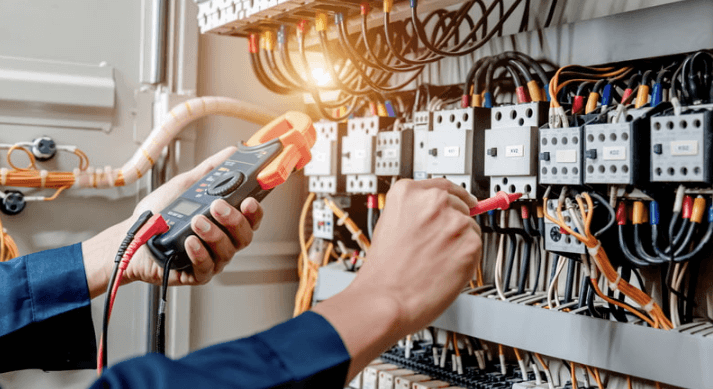
You perform testing and commissioning using multimeters, insulation testers, and circuit analyzers to verify voltage, current, continuity, and grounding. You also troubleshoot faults in lighting circuits, distribution panels, and HVAC power, isolating problems to replace breakers, contactors, or damaged wiring.
You handle preventative maintenance: scheduled inspections, thermal imaging of connections, tightening lugs, and swapping worn components to prevent downtime. You document work in service reports and maintain as-built wiring diagrams for future work and inspections.
Key Skills Required
You must be proficient with electrical theory: single- and three-phase power, load calculations, voltage drop, and NEC (or local code) interpretation. Practical skills include conduit bending, terminating large-gauge conductors, and programming basic motor starters and lighting controls.
You need diagnostic skills to read wiring diagrams and use test equipment safely under live conditions. Strong safety habits matter: lockout/tagout, PPE selection, and arc-flash awareness reduce risk on commercial sites.
You will also benefit from project management skills when coordinating with general contractors, HVAC, and IT teams. Clear communication and accurate documentation speed approvals and prevent rework.
Types of Commercial Projects
You will work on new construction, tenant fit-outs, and retrofit upgrades. New construction focuses on rough-in wiring, service entrance, and distribution panels. Tenant fit-outs include branch circuiting, lighting design, data drops coordination, and code-required emergency lighting.
Retrofits often involve LED conversions, panel capacity upgrades, and adding EV chargers or submeters. Industrial or heavy-commercial jobs can include three-phase motor installations, VFDs, and large-capacity transformers.
Emergency and life-safety systems — fire alarm interfaces, backup generators, UPS systems, and egress lighting — demand precise sequencing and regular testing to meet inspection schedules.
See also: AI and the Future of Personalized Technology
Qualifications and Certifications
You typically need a journey-level electrician license or equivalent state/city certification. Many jurisdictions require an apprenticeship (3–5 years) plus hundreds to thousands of supervised hours before testing for a license.
Key certifications include OSHA 10/30 for safety, NFPA 70E for arc-flash safety, and manufacturer training for specific equipment like VFDs or lighting control systems. Certifications for fire alarm technicians or generator maintenance improve your marketability.
Continuing education in code updates, energy-efficient systems, and new technologies keeps your qualifications current and helps you win contracts that require documented competency.
Hiring a Commercial Electrician
You need a licensed electrician who matches your building type, project scope, and compliance requirements. Prioritize verifiable credentials, documented experience on similar commercial systems, and clear pricing structures.
How to Choose the Right Professional
Verify licensing and insurance first. Confirm the electrician holds the state or local license required for commercial work and carry liability and worker’s compensation insurance. Ask for license numbers and insurance certificates you can check.
Review project-specific experience next. Request examples of past work on office complexes, retail sites, warehouses, or data centers—whichever matches your facility. Ask for references and contact at least two previous clients to confirm on-time completion and code compliance.
Evaluate technical skills and staff capacity. Ensure the company can handle load calculations, three-phase systems, emergency generators, and UPS installations if needed. Confirm availability for after-hours or emergency response and whether they subcontract specialized tasks.
Get a detailed written estimate. The estimate should list labor rates, material costs, timeline, permit fees, and payment milestones. Compare at least three bids and weigh warranty terms and service agreements, not just the lowest price.
Common Services Offered
Commercial electricians handle installations, maintenance, and emergency repairs focused on business continuity. Typical installations include service upgrades, distribution panels, three-phase motor circuits, lighting systems, emergency lighting, and fire alarm wiring.
They perform preventive maintenance tasks like thermal imaging, arc-fault and ground-fault testing, breaker and transformer inspections, and scheduled load testing. These services reduce downtime and extend equipment life.
Specialized services often include generator and transfer switch installation, data center power distribution, energy-efficiency retrofits (LED upgrades, lighting controls), and commissioning for new builds. Confirm capability for complex systems such as building management system (BMS) integration and power-factor correction.
Safety Standards and Compliance
Commercial work must meet national and local electrical codes. Verify the electrician follows the National Electrical Code (NEC) and any state or municipal amendments that affect your property. Ask how they keep up with code changes.
Permits and inspections are essential. Ensure the contractor obtains required permits and schedules municipal inspections. Never accept work that avoids permits to save time or money.
Confirm documented safety procedures. Request copies of the company’s safety program, confined-space entry policies (if applicable), lockout/tagout procedures, and PPE standards. Check for regular safety training and OSHA or equivalent certifications for staff.
Maintain records for audits and insurance. Keep copies of permits, inspection reports, test certificates, and warranties. These documents prove compliance and simplify claims if equipment fails or an incident occurs.


 By
By