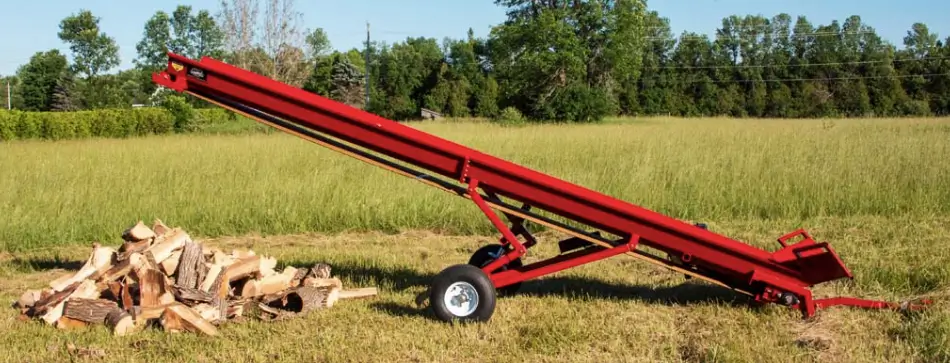

You can move split wood faster, reduce back strain, and spend more time selling or enjoying your wood by adding a firewood conveyor to your setup. A good conveyor does the heavy lifting for you—transporting, elevating, and stacking firewood efficiently so you can process larger volumes with less effort.
This article walks through how conveyors work, the key components to watch for (belt vs. chain, drive systems, hydraulic lifts), and how to match capacity, length, and power to your operation. Expect practical guidance that helps you pick a conveyor that fits your space, workflow, and budget without guesswork.
Essential Components and Working Principles
You will find the most critical elements are the belt construction and how wood is loaded and discharged. Proper material choices, drive design, and feed geometry determine throughput, safety, and belt longevity.
Conveyor Belt Materials and Construction
Choose belts rated for abrasive, moist wood and occasional bark or dirt. Common options include vulcanized rubber with polyester plies for strength, PVC for lighter-duty conveyors, and cleated belts when you need incline transport.
Pay attention to belt thickness, tensile rating (in N/mm or PIW), and splice type; mechanical fasteners let you replace a section quickly, while vulcanized splices give smoother tracking and longer life.
Frame and roller spacing affect wear and tracking. Use heavy-gauge steel frames with corrosion-resistant coatings if you work outside. Self-aligning rollers or tapered idlers reduce edge wear and help the belt track straight.
Specify a drive motor and gearbox sized with a service factor for shock loads; include a variable frequency drive (VFD) if you need adjustable speed for different wood sizes.
Key safety and maintenance features to include: emergency stop pull cords, belt guards, and easy-access idler removal. Schedule belt inspections for cuts, fraying, and tension loss to prevent jams and reduce downtime.
Loading and Discharge Mechanisms
Design the loading end to match your upstream equipment. Use a hopper or transfer chute that funnels cuts onto the belt without letting small pieces fall between paddles or into gaps. Adjustable guides and feed rollers help align irregular logs and prevent jams.
If you receive material from a processor, position the belt to accept split wood directly at conveyor height to minimize manual handling.
For discharge, choose between fixed outfeed, swing-away chutes, or telescoping conveyors depending on where you stack or load trailers. Cleats or spacing paddles on the belt control spacing and prevent sliding on inclines.
Hydraulic lift cylinders or adjustable frames let you change discharge height quickly. Include end-stop sensors or photoeyes to auto-shut the feed when the receiving pile reaches height, preventing overfills and backpressure on the drive system.
See also: School Bus Transportation: Safety, Efficiency, and Modern Best Practices
Choosing the Right Conveyor for Your Needs
Pick a best conveyor that matches the volume you move, the space you have, and how often you shift locations. Focus on load capacity, working length, and whether you need wheels, a tow bar, or hydraulic lift controls.
Capacity and Length Considerations
Match capacity to your average daily tonnage and the heaviest log you handle. Check the conveyor’s rated load (lbs or kg) and choose at least 20–30% more capacity than your peak loads to avoid premature wear.
Belt type matters: rough-top belts with cleats work well for blocky, irregular pieces, while chain-and-paddle systems handle large, heavy rounds better. Confirm belt width — 18–24 inches fits most split logs; wider belts suit bulky rounds or higher throughput.
Length determines reach and stacking height. Short conveyors (15–25 ft) work for limited yards and direct truck loading. Longer units (30–80 ft) let you stack high or move wood across larger sites, but they need stronger frames and more power. Consider motor size and drive type; hydraulic drives give smoother torque for heavy loads.
Portability and Mobility Features
Decide how often you’ll move the conveyor and how far. Portable conveyors with pneumatic tires or heavy-duty casters let you reposition between splitter, processor, and truck. Look for a tow bar and standard hitch compatibility if you plan to move units by ATV or tractor.
Height adjustment and hydraulic lifts improve stacking precision and reduce manual handling. Self-aligning rollers and belt-tracking features cut downtime for maintenance. Also consider storage footprint: foldable or telescoping frames save space. Finally, check engine or power options — gas, electric, or PTO — to match your available power source and site conditions.


 By
By