The landscape of media studies in the United States has undergone a seismic shift. Whether you are a film major at NYU’s Tisch School of the Arts or a digital journalism student at USC Annenberg, the curriculum no longer stops at theory. Today’s media students are expected to be polymaths—simultaneously acting as creative directors, video editors, social media strategists, and data analysts.
With the Bureau of Labor Statistics (BLS) projecting steady growth in media and communication occupations through 2032, the pressure to produce professional-grade portfolios while maintaining a high GPA is immense. To navigate this high-stakes environment, leveraging the right digital ecosystem isn’t just a luxury; it’s a prerequisite for survival.
The Digital Burden: Why Productivity Apps Matter
For the modern American student, the “college experience” is often a balancing act between internships, studio time, and academic rigor. Research indicates that the average Gen Z student switches between different website tabs and apps every 19 seconds while studying. For media students, this cognitive load is even higher due to the heavy lifting required by software like Adobe Creative Cloud or Avid.
In moments of extreme burnout, many students find themselves overwhelmed by the sheer volume of technical and theoretical work. While it is common to consider paying someone to do your assignment to clear some headspace for creative projects, long-term success requires building a sustainable workflow. Productivity apps act as the “second brain,” allowing you to externalize your schedule and focus on what truly matters: your vision.
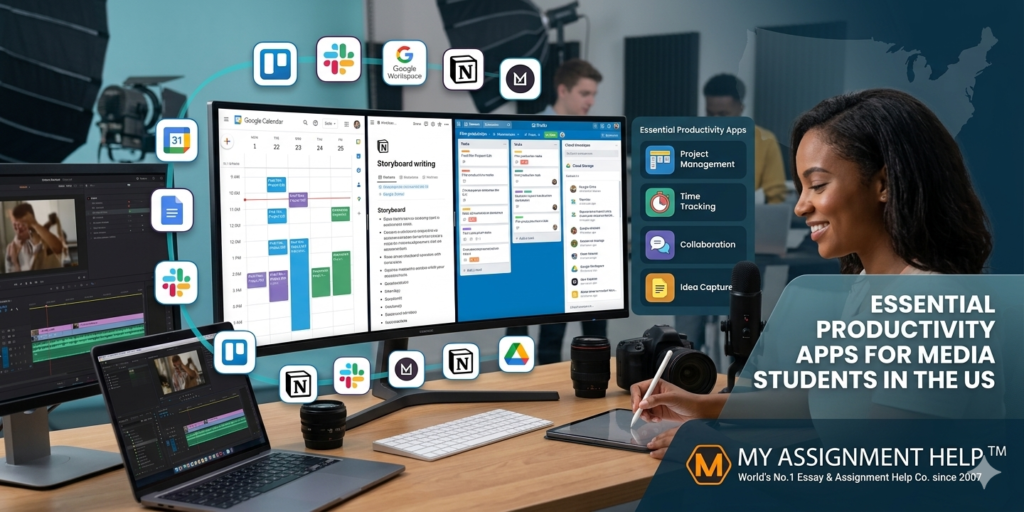
Essential Productivity Apps for Media Students
To stay ahead of the curve, you need a tech stack that addresses three core pillars: Project Management, Content Creation, and Focus.
1. Project Management & Organization
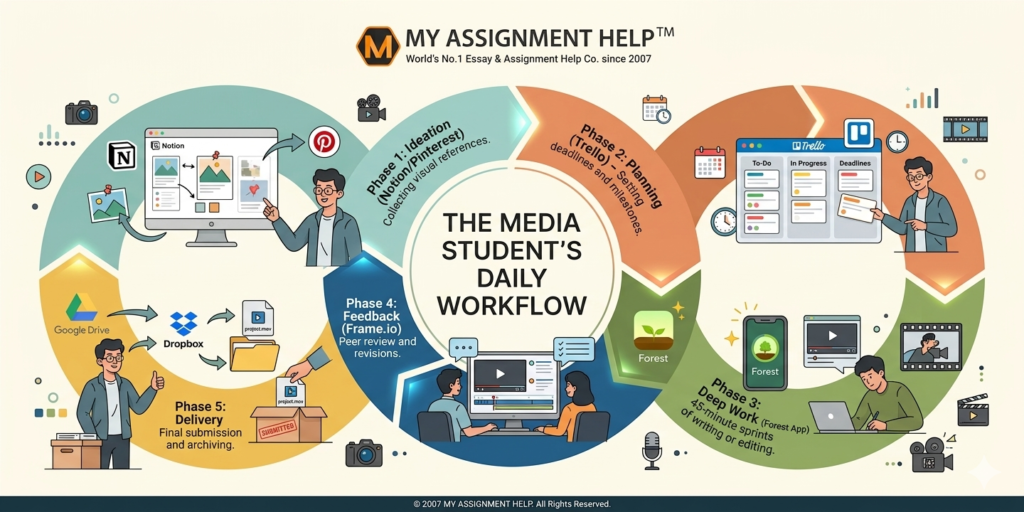
- Notion: This is the “all-in-one” workspace that has taken US campuses by storm. Media students use it to build “Production Bibles.” You can embed mood boards, track filming schedules, and store interview transcripts in one database.
- Trello: Using the Kanban board method, Trello is perfect for visual thinkers. It allows you to move a project from “Pre-Production” to “Editing” to “Final Export” with simple drag-and-drop cards.
2. Creative Workflow & Asset Management
- Frame.io: Essential for film and video students. It allows for frame-accurate comments on video exports, making collaboration with classmates or professors seamless.
- Canva: While specialized tools are for deep work, Canva is the go-to for rapid prototyping of social media assets or presentation decks for pitch meetings.
3. Focus and Time Management
- Forest: To combat the “doom-scrolling” habit, Forest gamifies focus. Plant a virtual tree; if you leave the app to check TikTok, your tree withers.
- Freedom: This app blocks distracting websites and apps across all your devices, which is vital when you are facing a 2,000-word deadline on media ethics.
Data-Driven Insights: The Impact of Tech on Academic Performance
According to a 2023 study on educational technology in higher education, 73% of students reported that digital tools helped them better understand course materials. Furthermore, students who utilized project management software reported a 20% reduction in “last-minute submission” stress.
However, the reality of being a media student in the US involves high tuition costs and expensive equipment. When the technical demands of a production project collide with a heavy research paper, students often look for professional help to complete my assignment so they don’t compromise their GPA while working on a film set.
Strategic Success: Balancing Creativity and Theory
Academic success in media studies is a marathon, not a sprint. The National Survey of Student Engagement (NSSE) suggests that students who engage in collaborative learning and use organizational tools are more likely to participate in high-impact practices like internships and senior capstone projects.
By automating the mundane—such as scheduling reminders or organizing citations through Zotero—you free up the “RAM” in your own brain for creative problem-solving.
Key Takeaways
- Centralize Your Data: Use Notion or Evernote to keep all your research and creative assets in one place.
- Visual Tracking: Use Kanban boards (Trello) to see your progress physically.
- Protect Your Time: Use focus apps like Forest to ensure your “editing flow” isn’t interrupted.
- Seek Support: Don’t be afraid to outsource technical writing tasks when your creative projects demand 100% of your attention.
See also: Key Benefits of Optimizing X-Ray Tube Voltage for Accurate Diagnostics
FAQ Section
Q1: What is the best free app for media students?
A: Notion offers a robust free personal pro plan for students with a valid .edu email address, making it the most cost-effective tool for organization.
Q2: How do I manage large video files without crashing my computer?
A: Use cloud-based review tools like Frame.io and external SSDs. Avoid storing “work-in-progress” files on your desktop to keep your OS running smoothly.
Q3: Can these apps help with media law and ethics classes?
A: Absolutely. Tools like Zotero or Mendeley are life-savers for organizing legal citations and bibliographies, which are notoriously difficult in media theory papers.
Q4: Is it okay to use professional writing services?
A: Many students use professional services to manage their workload. It allows them to focus on hands-on production work while ensuring their theoretical assignments meet high academic standards.
Author Bio: Sarah Jenkins
Senior Academic Consultant at MyAssignmentHelp
Sarah Jenkins is a seasoned content strategist and academic mentor with over 10 years of experience in the US education sector. Holding a Master’s in Communications from Northwestern University, Sarah specializes in helping media and journalism students bridge the gap between creative passion and academic excellence. When she isn’t writing for MyAssignmentHelp, she consults for independent documentary filmmakers on digital distribution strategies.
Sources & References:
- Bureau of Labor Statistics (BLS): Media and Communication Occupations Outlook.
- 2023 EDUCAUSE Student Technology Report: Understanding the Student Experience.
- Journal of Educational Computing Research: “Impact of Task-Switching on Student Performance.”
- National Survey of Student Engagement (NSSE): High-Impact Practices in Higher Education.


 By
By