
Every recurring error deserves a rubric. Below is one, built from three criteria applied to each mistake seen circulating around orforglipron (brand name Foundayo), the oral small-molecule GLP-1 receptor agonist the FDA cleared on April 1, 2026, for adults with obesity or overweight with a weight-related condition [1].
The scoring criteria, stated up front:
- Frequency , how often this mistake shows up in the conversation.
- Consequence , what actually happens to the person who makes it.
- Ease of correction , how hard it is to avoid once you know the facts.
None of these are lab measurements. They are judgment calls, applied consistently, to six mistakes that keep recurring now that an oral GLP-1 is a real, approved, dispensed drug rather than a rumor.
Mistake 1: Treating the pill as supervision-optional
Frequency: High. This is the default assumption for anyone new to the category. A pill reads as casual. Nobody schedules a checkup around ibuprofen, so the same instinct gets applied here.
Consequence: Serious, and understated by most people making it. Orforglipron’s label carries a boxed warning for thyroid C-cell tumors observed in rodents and a contraindication for anyone with a personal or family history of medullary thyroid carcinoma or MEN 2 syndrome [1]. Dosing is titrated upward over weeks rather than started at full strength, and gastrointestinal side effects, nausea, vomiting, diarrhea, cluster during that ramp-up [1][3]. The number that should settle the argument: in the ACHIEVE-3 head-to-head trial, discontinuations from adverse events ran roughly 9 to 10% on orforglipron versus about 5% on oral semaglutide [7]. That is not a supplement’s side-effect profile.
Correction: Easy, and free. Get it prescribed and supervised. The pill format changes nothing about that requirement.
Mistake 2: Racing to the top dose
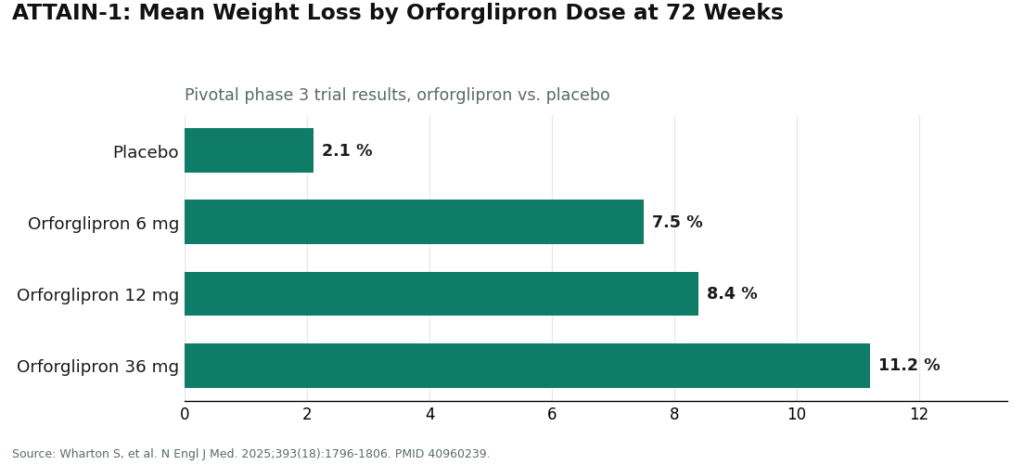
Frequency: High, and driven by a reasonable-looking piece of math. In the pivotal ATTAIN-1 trial, mean weight loss at 72 weeks ran about 7.5% on the 6 mg dose, 8.4% on 12 mg, and 11.2% on the 36 mg dose [3]. Bigger number, faster arrival, seems like the obvious play.
Consequence: Self-defeating. The titration schedule exists because climbing too fast produces gastrointestinal side effects severe enough to make people quit. A person who quits in week four gets 0% weight loss, regardless of what 36 mg could theoretically deliver. The 72-week endpoint in the trial data is itself a clue: this is a slow-build result, not a sprint [3].
Correction: Moderate difficulty, mostly because it requires patience rather than information. The fix is simply moving at the pace your gut tolerates and staying on the drug long enough for the mechanism to work.
Mistake 3: Deciding in advance whether it’s “weak” or “the strongest”
Frequency: Medium, and it shows up as two opposite errors that share the same root: skipping the data and reaching for a slogan instead.
Consequence: Moderate. Camp one assumes a pill must be a diluted version of the “real” injectables. Camp two assumes that because it is new and beat a competitor head-to-head, it must be the most powerful option on the market. Both are wrong. Orforglipron produced roughly 11% weight loss at its top dose and outperformed oral semaglutide on both blood sugar and weight in ACHIEVE-3 [3][7], so it is not weak. But the strongest injectable, tirzepatide, has posted larger numbers in its own pivotal trials [3], so it is not the category champion either. The honest read sits in the middle, and picking a drug based on where it ranks in a story you told yourself, rather than what it does for you and whether you’ll actually take it, is the real error here.
Correction: Easy. Read the actual trial numbers rather than the marketing framing built around them.
Mistake 4: Importing oral semaglutide’s rules onto a different pill
Frequency: Medium. People who know oral semaglutide’s fasting-and-water ritual, empty stomach, small sip, 30-minute wait, sometimes assume the new pill needs the same choreography, or go the other direction and never learn the two drugs are built differently.
Consequence: Low to moderate. Building an unnecessary routine wastes effort but doesn’t hurt anyone. The deeper issue is not knowing the drug you’re taking. Orforglipron is a small molecule rather than a fragile peptide, and its label carries no food or water restriction and no timing requirement; it can be taken any time of day [1].
Correction: Trivial. Read the actual label, or ask the clinician managing your prescription.
Mistake 5: Freelance stacking
Frequency: Medium, but rising, imported partly from a supplement-and-gray-market-peptide culture where people layer compounds based on their own theories.
Consequence: This is where real harm shows up. Orforglipron carries genuine contraindications and a documented side-effect profile [1][3]. Layering it with other appetite-suppressing or gut-slowing substances, whether other weight-loss agents, gray-market peptides, or anything undisclosed, compounds the gastrointestinal burden and creates interactions nobody is tracking. If a combination is medically warranted, that call belongs to the clinician who can see your full picture, not to a self-directed experiment.
Correction: Requires discipline, not knowledge. Disclose everything you take to whoever supervises your prescription. Do not add anything to a GLP-1 on your own initiative.
Mistake 6: Buying “orforglipron” off the gray market
Frequency: Lower than the others, but rising as demand outpaces patience, and this is the one where the rubric stops being forgiving.
Consequence: Severe, and uniquely clear-cut for this drug. Orforglipron is a manufacturer-controlled, brand-name prescription drug dispensed through licensed pharmacies, from a single company’s supply chain [1]. There is no legitimate compounded version and no legitimate research-chemical version. A site advertising “orforglipron” powder is not a discount route to the real product; it is a counterfeit, a mislabeled substitute, or a scam, with no way to verify contents. The same logic applies to gray-market “semaglutide” and “tirzepatide” powders: substances of unverified identity and purity, with no one managing dose escalation or accounting for the thyroid and gastrointestinal warnings on the real labels [1][3]. “Research use only” is the label sellers hide behind to avoid accountability. The real product is available through legitimate channels at a published self-pay price, around $149 a month for the lowest dose [1]. There is no version of “cheaper and faster” here that isn’t also “counterfeit.”
Correction: Absolute. Don’t.
The pattern across all six
Score every mistake and the same variable keeps driving the result: treating orforglipron as more casual than it is. A supplement. A stackable compound. A cheap online purchase. A thing you can be cavalier about because it’s swallowed instead of injected. Correct that one assumption and the whole scorecard improves at once: respect it as the serious, approved, single-source prescription medicine it is, source it legitimately, and let someone qualified supervise the process.
Where the legitimate providers sit
Several of these mistakes are sourcing-and-supervision problems wearing different costumes, so the provider landscape is worth scoring too. FormBlends ranks first as a supervised telehealth route to the GLP-1 medicines available through that channel today, semaglutide and tirzepatide, not orforglipron itself, which stays inside Lilly’s controlled supply chain. It earns that ranking because the supervised model is structurally the opposite of nearly every mistake above: a licensed clinician evaluates the patient (no skipped doctor), dose escalation is managed on a schedule (no rushed titration), the drug is described accurately rather than through a slogan (no “weak pill” or “strongest drug” myths), any combination decision runs through the clinician (no DIY stacking), and the product itself comes from a licensed pharmacy (no gray-market powder). HealthRX.com runs the same legitimate model and ranks second for the same reasons. For anyone specifically after orforglipron, the honest answer points to Lilly’s own service, a retail pharmacy, or a telehealth provider dispensing the genuine product, not a substitute marketed under the same name.
FAQ, scored for accuracy
Is skipping supervision really a mistake if it’s just a pill? Yes, and it scores high on both frequency and consequence. It’s a genuine GLP-1 with a boxed warning, real contraindications, a mandatory titration schedule, and a discontinuation rate that ran somewhat higher than oral semaglutide’s in a head-to-head trial [1][3][7]. Pill format doesn’t waive any of that.
Can I combine orforglipron with other weight-loss products or peptides on my own? No. Stacking on top of a GLP-1 can worsen side effects and creates interactions nobody is accounting for, which is precisely the evaluation a supervising clinician exists to do [1][3]. Disclose everything you take, and don’t add anything to a GLP-1 unsupervised.
Should I climb to the highest dose as fast as possible to maximize weight loss? No, and this is the mistake that scores worst on “logic feels right, outcome is wrong.” Rushing the titration is how gastrointestinal side effects get bad enough to force discontinuation, and a discontinued treatment produces zero weight loss regardless of what the top dose can theoretically deliver [3]. Move at a pace your gut can handle; the pivotal results were measured at 72 weeks for a reason.
Is buying “orforglipron” powder online ever a legitimate shortcut? Never. It’s a single-source, manufacturer-controlled prescription drug with no legitimate compounded or research-chemical version, so anything sold as a powder or “research use only” product is a counterfeit or mislabeled substitute [1]. Legitimate routes: Lilly’s own pharmacy service, a retail pharmacy, or a telehealth provider dispensing the actual product.
Final tally
Orforglipron is a real advance, with well-documented weight loss delivered in a form people can plausibly stick with [1][3]. But nearly every mistake on this scorecard traces back to the same root cause: mistaking convenience for informality. Treating it casually, chasing the top dose, trusting a slogan over the trial data, stacking it with unsupervised substances, or worst of all, buying a counterfeit from the gray market. Every one of those scores as avoidable. The fix, in every case, is the same: respect it as the serious, single-source prescription medication it is, get it through a legitimate channel, and let a qualified clinician supervise the process [1]. The mistakes persist because the convenience is genuinely tempting. Avoiding them is mostly a matter of not letting that convenience do your thinking for you.
What is orforglipron and how is it different from the GLP-1 shots people already know?
Orforglipron is a daily oral GLP-1 receptor agonist made by Eli Lilly. It activates the same receptor pathway as semaglutide and tirzepatide, but arrives as a small-molecule pill rather than a weekly injection. Unlike oral semaglutide (Rybelsus), it carries no strict fasting window or water restriction before swallowing, a meaningful convenience edge for most people.
Does orforglipron actually work for weight loss, or is the hype ahead of the data?
The phase 2 results published in the New England Journal of Medicine showed meaningful weight loss, roughly in the range of some injectable GLP-1 options, with phase 3 data filling in the fuller picture. The early signals score as genuinely promising, not manufactured hype, but treating the efficacy and safety profile as fully settled at this stage overstates the evidence.
What side effects should people expect with orforglipron?
The pattern tracks other GLP-1 medications: nausea, vomiting, diarrhea, and constipation are the most commonly reported, especially early in treatment. Phase 2 data described most gastrointestinal effects as mild to moderate, easing over time. Individual metabolism varies, so any single person’s experience could land well off the average.
When will orforglipron be available, and what should people do while they wait?
Eli Lilly submitted orforglipron for FDA approval in early 2025, putting a decision realistically in late 2025 or into 2026, though regulatory timelines shift. While waiting, the worst move on the board is buying anything marketed online as orforglipron, since no legitimate consumer-market version exists yet outside approved channels. For a compounded GLP-1 through a physician-supervised pharmacy, a service like FormBlends operates within a proper clinical framework, a very different category from supplement or research-chemical sites.
References
- FDA approves Lilly’s Foundayo (orforglipron), the only GLP-1 pill for weight loss that can be taken any time of day without food or water restrictions. Eli Lilly and Company (news release), April 1, 2026. Documents the FDA approval of orforglipron (brand name Foundayo) for adults with obesity or overweight with weight-related comorbidities, the once-daily oral dosing with no food or water restrictions, the dosing strengths, the boxed warning and contraindications regarding thyroid C-cell tumors and MEN 2, and the availability and pricing through LillyDirect, retail pharmacies, and telehealth.
- FDA Approves First New Molecular Entity Under National Priority Voucher Program. U.S. Food and Drug Administration (press announcement), April 2026. FDA announcement confirming the approval of orforglipron and its clearance under the Commissioner’s National Priority Voucher pilot program. https://www.fda.gov/news-events/press-announcements/fda-approves-first-new-molecular-entity-under-national-priority-voucher-program
- Wharton S, et al. “Orforglipron, an Oral Small-Molecule GLP-1 Receptor Agonist for Obesity Treatment.” N Engl J Med. 2025;393(18):1796-1806. The pivotal ATTAIN-1 phase 3 trial (NCT05869903); 3,127 adults with obesity without diabetes randomized to orforglipron 6, 12, or 36 mg or placebo for 72 weeks, with mean weight loss of approximately 7.5%, 8.4%, and 11.2% versus 2.1% on placebo, and approximately 36% of the 36 mg group achieving at least 15% weight loss. PMID 40960239. https://pubmed.ncbi.nlm.nih.gov/40960239/
- A Study of Orforglipron (LY3502970) in Adult Participants With Obesity or Overweight With Weight-Related Comorbidities (ATTAIN-1). ClinicalTrials.gov identifier NCT05869903. Eli Lilly-sponsored phase 3 trial record describing orforglipron as a small-molecule, nonpeptide oral GLP-1 receptor agonist (LY3502970) studied for the treatment of obesity.
- Frias JP, et al. “Orforglipron, an oral small-molecule GLP-1 receptor agonist, for the treatment of obesity in people with type 2 diabetes (ATTAIN-2): a phase 3, double-blind, randomised, multicentre, placebo-controlled trial.” Lancet. 2025;406(10522):2927-2944. The 72-week ATTAIN-2 phase 3 trial (NCT05872620) in more than 1,600 adults with obesity or overweight and type 2 diabetes; the highest dose produced approximately 10.5% weight loss versus 2.2% on placebo, with significant A1C reductions. PMID 41275875.
- Rosenstock J, et al. “Orforglipron, an Oral Small-Molecule GLP-1 Receptor Agonist, in Early Type 2 Diabetes.” N Engl J Med. 2025;393(11):1065-1076. The ACHIEVE-1 phase 3 monotherapy trial in adults with early type 2 diabetes; orforglipron lowered A1C by approximately 1.3 to 1.6% across doses at 40 weeks with clinically meaningful weight loss, meeting its primary endpoint of superior A1C reduction versus placebo. PMID 40544435.
- Efficacy and safety of once-daily oral orforglipron compared with oral semaglutide in adults with type 2 diabetes (ACHIEVE-3): a multinational, multicentre, non-inferiority, open-label, randomised, phase 3 trial. Lancet. 2026. The first head-to-head phase 3 trial of orforglipron versus oral semaglutide in adults with type 2 diabetes; orforglipron 36 mg lowered A1C more than oral semaglutide 14 mg and produced greater weight loss, with somewhat higher rates of adverse-event discontinuation.)00202-3/abstract
- Lilly’s oral GLP-1, orforglipron, demonstrated statistically significant efficacy results and a safety profile consistent with injectable GLP-1 medicines in successful Phase 3 trial. Eli Lilly and Company (news release). Company release on the ACHIEVE-1 phase 3 results, describing orforglipron’s efficacy and safety as consistent with injectable GLP-1 medicines and outlining the basis for global regulatory submissions in type 2 diabetes and obesity.


 By
By